Relapsed Lymphoma · CD79b CAR-T · Stem Cell Transplant · 10 October 2026
Relapsed Lymphoma Treatment in China: Two Patients Return to Sport After Individualised Care
Hospital
Beijing GoBroad Hospital; Dr Hu Kai's team; Professor Ke Xiaoyan also assessed Mr Yang
Abu's diagnosis
Primary gastric lymphoma, diagnosed in 2021; relapse and progression before planned transplant
Mr Yang's diagnosis
Grade 3B follicular lymphoma, diagnosed in 2017; repeatedly progressive disease with lung involvement
Abu's reported response
PET/CT complete remission in November 2025 after Pola+MINE; later transplant and CAR-T-related treatment
Mr Yang's reported response
CD79b-positive; CD79b CAR-T on 30 April 2026; partial remission at one month, complete remission at three months
Follow-up
Both continue regular reviews; individual results do not predict another patient's outcome
Partner story: Progression Before Transplant and Nine Years of Treatment—Two Lymphoma Patients Return to the Court and Pitch
In 2025, Abu from Xinjiang and Mr Yang from Beijing came to Beijing GoBroad Hospital at different times. They had different lymphoma treatment histories and faced their own treatment difficulties.
Abu relapsed after remission with initial treatment, and his disease progressed again after second-line treatment. Mr Yang had lived with follicular lymphoma for nine years and undergone multiple treatments, but his lung lesions worsened and he had difficulty breathing. Under Dr Hu Kai's team, they received different regimens according to their individual conditions. Today, Abu is back on the football pitch and Mr Yang has picked up his tennis racket again.
Disease Progressed Again Before Transplant: His Treatment Plan Was Reassessed at Beijing GoBroad Hospital
In July 2025, Abu travelled from Xinjiang to Beijing GoBroad Hospital with his wife Parry. He had been diagnosed with primary gastric lymphoma in 2021 and achieved complete remission (CR) after six cycles of R-CHOP chemotherapy. In November 2024, the disease relapsed, with a gastric mass measuring about eight centimetres. Second-line treatment brought another remission and he completed haematopoietic stem cell collection, but disease progression was discovered again as he prepared for transplant.
Faced with this result, Parry read medical information and consulted several specialists before deciding to bring her husband to Beijing GoBroad Hospital. Taking Abu's previous medication, disease progression and examination results into account, Dr Hu Kai's team initially used R-GVD combined with a bispecific antibody, but the response was unsatisfactory. Further investigation found a concurrent fungal infection. After assessing both his disease and physical condition, the team changed the treatment strategy to Pola+MINE.
In November 2025, Abu's PET/CT assessment showed complete remission (CR). Parry recalled the moment:
“Dr Hu ran into our room: ‘Congratulations, Abu is in CR.’ Dr Guo also rushed in to congratulate me. Usually calm and rational, I was suddenly in tears.”
Afterward, Abu continued with transplant and CAR-T-related treatment. Once his inpatient treatment ended, he and his wife returned to Xinjiang and continued regular check-ups. He has now returned to his school as a football coach and has also founded his own goalkeeping club.
Nine Years with Lymphoma: He Returned to the Tennis Court
In February 2025, Mr Yang came to Beijing GoBroad Hospital because his lung lesions were worsening and he was having difficulty breathing. Since his diagnosis of grade 3B follicular lymphoma in 2017, he had undergone chemotherapy, targeted drugs, bispecific antibodies, CAR-T and multiple clinical trials, yet the disease repeatedly progressed.
“I gradually noticed a pattern: my initial response to medication was always very good and it worked quickly, but resistance developed rapidly, so I had to change drugs.”
From 2023 onward, Mr Yang's lung lesions gradually worsened, accompanied by repeated infections and fever. He was admitted to intensive care several times. Around Chinese New Year in 2025, progression of the lung tumours caused persistent coughing and breathing difficulty, leaving him dependent on high-flow oxygen therapy.
On the advice of doctors at another hospital, Mr Yang came to Beijing GoBroad Hospital. Professor Ke Xiaoyan and Dr Hu Kai reviewed his years of treatment, previous drug responses and current condition to reassess the options. Dr Hu Kai's team recombined previously used drugs into a treatment regimen. After about a week, his lung condition began to improve and the continuous high-flow oxygen he had needed for about three months was discontinued. The team then continued to adjust the regimen according to his response and physical condition, which gradually improved.
“In July, I started to have more strength when walking. After chemotherapy in September, I walked a five-kilometre loop around the Life Science Park where Beijing GoBroad Hospital is located. In October, I resumed tennis once or twice a week.”
In March 2026, Mr Yang's disease progressed again. Testing found the CD79b target to be positive, and the medical team assessed subsequent treatment options in light of his previous therapies. On 30 April, he received CD79b CAR-T. He achieved partial remission (PR) after one month, and PET/CT at three months showed complete remission (CR).
“My wife said, ‘Looking at this PET/CT scan, it has never been this clear since you became ill.’ It really was the first time in nine years.”
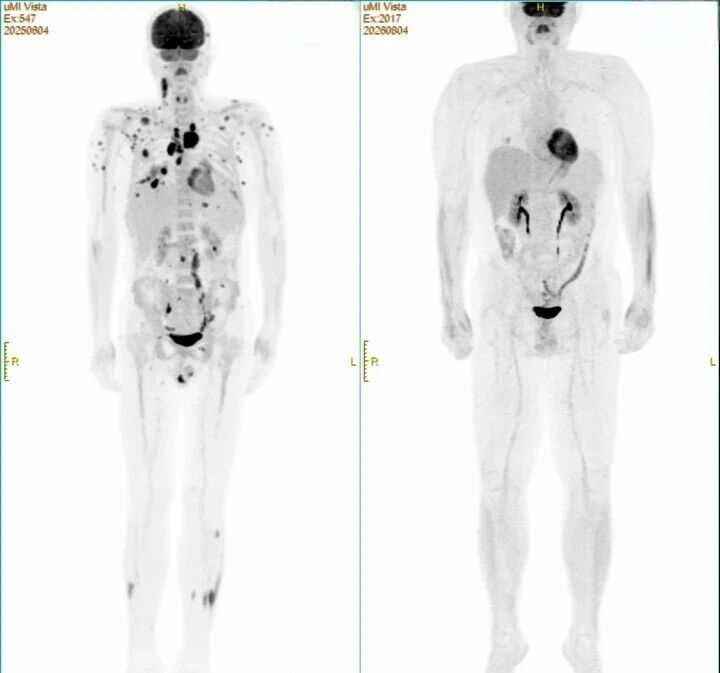
Today, Mr Yang continues regular follow-up and has resumed tennis, cooking and building Lego. Looking back on nine years of treatment, he said:
“Fear of disease must not take away our right to live a normal life. Live your life and get your treatment; do not spend every day anxiously staring at laboratory reports.”
Final Thoughts
Abu and Mr Yang had different disease types and treatment histories, and received different regimens at Beijing GoBroad Hospital. For people with lymphoma, whether newly diagnosed or undergoing subsequent treatment, a comprehensive assessment must consider disease characteristics, examination results, previous treatment responses and physical condition. Management should be adjusted promptly as the condition changes.
Abu has returned to football and Mr Yang has resumed tennis. They still need regular reviews and follow-up, but everyday life—work, exercise and time with family—is continuing.
Original article note: This content was compiled from the public account of Dr Hu Kai's team at Beijing GoBroad Hospital, ‘Hu Kai's NHL and MM CAR-T Commando Team’. Patients differ in disease, physical condition and treatment response. The treatment courses and results described represent individual cases only and do not mean that other patients will achieve the same outcomes. A professional doctor should formulate each treatment plan following a comprehensive assessment of the patient's actual circumstances.
Original references: 1. ‘From Urumqi to Beijing: A Uyghur Wife Accompanies Her Husband Through Five Years of Lymphoma’ — https://mp.weixin.qq.com/s/U9-NYROsM_on9o-rlv-1OA. 2. ‘Nine Years: He Made His Life a Beam of Light’ — https://mp.weixin.qq.com/s/7s69uZH0rtYZqYEF3-8KQg. Content compilation: T. Review: Yueli, Dong, Nan.
Privilege Medical: Questions About Lymphoma Treatment in China
The following patient guidance is added by Privilege Medical and is not part of the original hospital story. These are stories of patients treated within China, not evidence of international-patient outcomes.
What does this case show about relapsed or refractory lymphoma treatment?
The source documents individualised reassessment after lymphoma relapse or progression. Abu's care included R-CHOP, R-GVD with a bispecific antibody, Pola+MINE, and later transplant and CAR-T-related treatment. Mr Yang's care included reassessment of previous medicines and CD79b CAR-T after a positive target test. These are not interchangeable treatment recommendations: the hospital's lymphoma specialists must review the exact diagnosis, previous therapies, infection status and overall fitness.
Does CD79b CAR-T guarantee remission or eligibility for every patient?
No. Mr Yang's grade 3B follicular lymphoma was CD79b-positive, and his own PET/CT showed complete remission three months after treatment. That result does not establish a cure, guarantee the same response for others, or confirm that this treatment is currently available to every overseas patient. Suitability, availability and any clinical-trial requirements must be confirmed directly with the treating hospital.
How can overseas families request a lymphoma treatment assessment?
If you, a friend or a relative has lymphoma—including relapsed lymphoma, refractory lymphoma or follicular lymphoma—and would like to explore treatment in China, contact Privilege Medical for a free consultation. With the patient's permission, upload their diagnosis and pathology reports, treatment history and available imaging reports through our Free Case Feasibility Assessment form. We help connect families with hospital specialists for review and coordinate communication about possible next steps. Our consultation and coordination service carries no fee for patients; this does not mean hospital treatment, medicines, travel or accommodation are free. Do not delay urgent care while seeking an assessment.
Treatment timeline
- 2017 · Mr YangGrade 3B follicular lymphoma diagnosed; multiple treatment lines followed over nine years.
- 2021 · AbuPrimary gastric lymphoma diagnosed; complete remission after six R-CHOP cycles.
- Nov 2024 · AbuRelapse with an approximately 8 cm gastric mass; second-line remission and stem cell collection followed, then progression before transplant.
- Feb 2025 · Mr YangArrived at Beijing GoBroad with worsening lung disease; individualised drug recombination improved breathing after about one week.
- Jul–Nov 2025 · AbuTreatment reassessed at Beijing GoBroad; Pola+MINE followed by PET/CT complete remission in November. Transplant and CAR-T-related care followed.
- Mar–Apr 2026 · Mr YangProgression in March; CD79b positivity confirmed; CD79b CAR-T administered on 30 April.
- 1–3 months laterMr Yang achieved partial remission at one month and complete remission on PET/CT at three months.