Substitute Drug Testing
A mini-tumor grown from the patient's own tissue is used to test drugs outside the body, avoiding unnecessary trial-and-error on the patient.
Organoid technology grows a 'mini-tumor' from the patient's own cells in the lab. It predicts which chemotherapy, targeted therapy, immunotherapy or CAR-T regimen will actually work — turning blind trial-and-error into precision medicine.
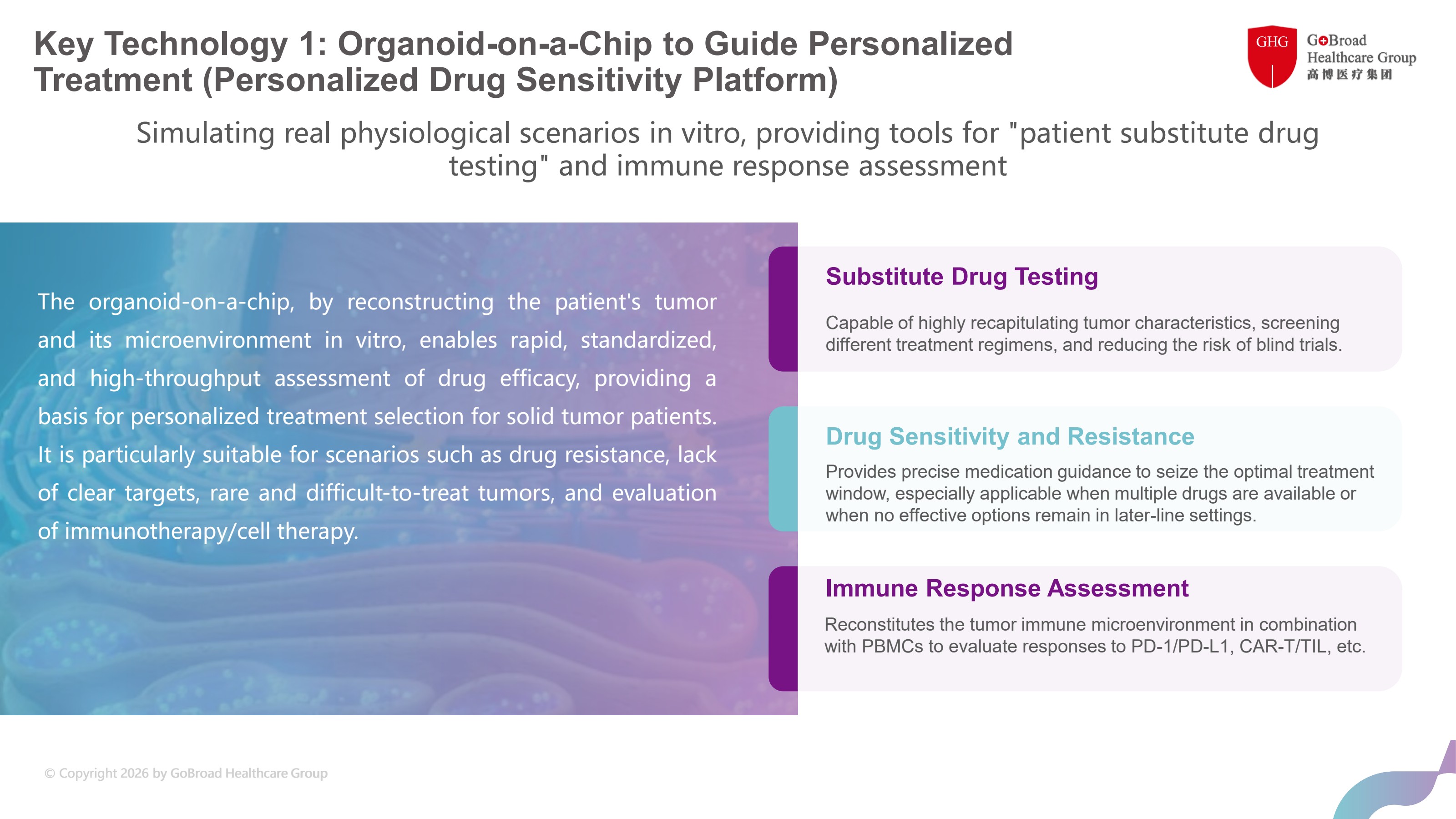
In simple terms, an organoid is a patient's 'mini-tumor' grown in the laboratory. We use it to test which drug is most effective — like giving the tumor a 'body double' to try medicines first, then treating the patient with the best option.
Highly recapitulates the patient's tumor characteristics.
Testing report available in 2–4 weeks.
Clinically validated accuracy over 85%.
The Dilemma of Traditional Treatment
The Organoid Solution
Core Applicable Population
Not Suitable For
Main Applicable Tumor Types
Solid tumors: lung, gastric, colorectal, breast, pancreatic, etc. | Nervous-system tumors: glioma, medulloblastoma, etc. | Rare cancers: cholangiocarcinoma, sarcoma, neuroendocrine tumors, etc.
The entire workflow takes 2–4 weeks, quickly securing valuable treatment time for the patient.
1–2 days — tumor tissue or malignant effusion is obtained by biopsy or surgery.
8–9 days — the patient's 'mini-tumor' is grown in the laboratory.
7–8 days — multiple drugs and combinations are screened to see which works best.
1–2 days — a precision medication recommendation is delivered to guide clinical treatment.
A mini-tumor grown from the patient's own tissue is used to test drugs outside the body, avoiding unnecessary trial-and-error on the patient.
Identify the most effective regimen from chemotherapy, targeted therapy, immunotherapy or CAR-T before the first dose is given.
Results are ready in 2–4 weeks, giving early-stage patients more options and late-stage patients a chance when standard therapies fail.
Precision testing improves response rates, lowers resistance risk and reduces side effects from ineffective drugs.
Published clinical studies in Science demonstrate the high reliability of organoid technology.
The two technologies complement each other and together support precision medicine.
| Dimension | NGS Genetic Testing | Organoid Testing |
|---|---|---|
| What it detects | Gene mutation profile | Actual drug response |
| Accuracy | ~60–70% | ~85%+ |
| Sample required | Tissue or blood | Fresh tumor tissue / effusion |
| Turnaround | 7–14 days | 14–28 days |
| Clinical insight | Predicts drug sensitivity | Directly validates efficacy |
Free Case Feasibility Assessment
Based in Hong Kong and serving international patients, Privilege Medical bridges you to leading Class 3A and JCI-accredited hospitals in mainland China. We do not provide medical care directly — we coordinate specialist matching, medical visa support and on-the-ground concierge from your first enquiry to post-treatment follow-up.
Complete the form below. Our coordination team responds within 1–2 business days with a complimentary assessment covering clinical feasibility, specialist matching and an indicative admission timeline.
Privacy Notice
Privilege Medical is a Hong Kong–based medical concierge and does not provide clinical care. Personal data and medical information you submit are collected, held and used strictly for the purposes of case assessment, specialist matching and coordination of medical services in mainland China, in accordance with the Personal Data (Privacy) Ordinance (Cap. 486) of Hong Kong.
Your data may be transferred to our partner hospitals, treating clinicians and authorised service providers (including translators and travel coordinators), some of whom are located outside Hong Kong. We take reasonable steps to keep your information confidential and secure, and we do not sell your data to any third party.
You have the right, under the PDPO, to request access to and correction of the personal data we hold about you, and to withdraw consent at any time by writing to service@privilegemedical.com. Information submitted via this form is not encrypted end-to-end; please avoid including highly sensitive identifiers (e.g. ID numbers) in the free-text fields.