01
CAR-T Product
The foundation of target recognition and function — CAR structure design, plasmid quality and stability, viral vector process and titer.
CAR-T (Chimeric Antigen Receptor T-Cell Immunotherapy) is a cutting-edge, personalized gene therapy. It uses genetic engineering to modify a patient's own T lymphocytes so they can accurately identify and attack tumor cells — installing a "precision navigation system" on the immune cells to autonomously find and destroy cancer within the body's complex internal environment.

CAR-T is not a molecule — it is a living, self-replicating therapy manufactured individually for each patient. By expressing chimeric antigen receptors, T-cells gain the ability to recognise tumor-specific antigens; upon binding they activate and release perforin and granzymes to directly kill tumor cells.
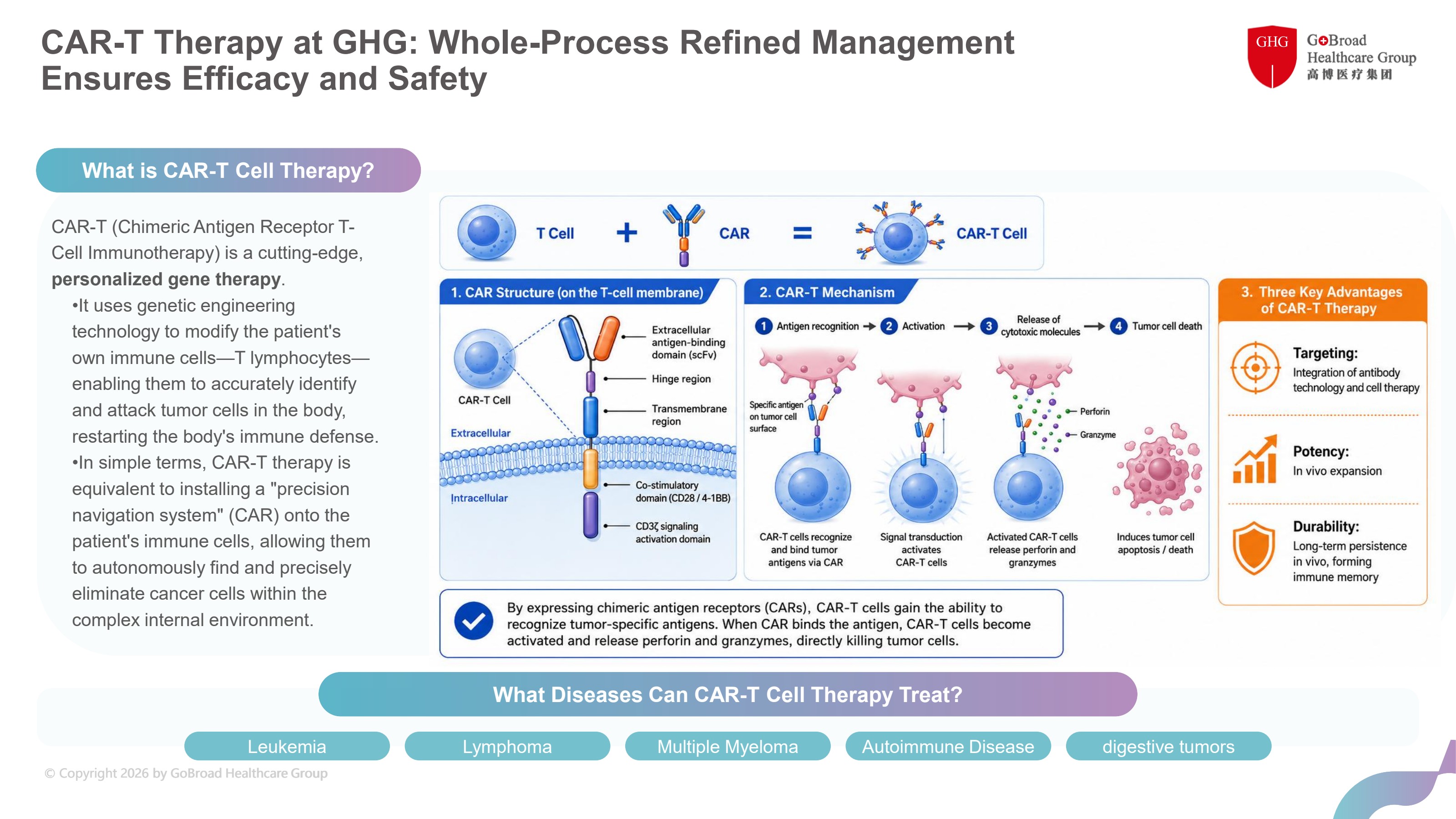
Antigen Recognition
CAR-T cells recognize tumor antigens via the CAR.
Activation
Signal transduction activates the CAR-T cell.
Cytotoxic Release
Activated CAR-T cells release perforin and granzymes.
Tumor Cell Death
Induces apoptosis of the tumor cell.
Integration of antibody technology and cell therapy — molecular-level precision.
In vivo expansion — hundreds of millions of doses from a single infusion.
Long-term persistence with formation of immune memory against relapse.
Whole-process refined management from patient screening to post-infusion monitoring.
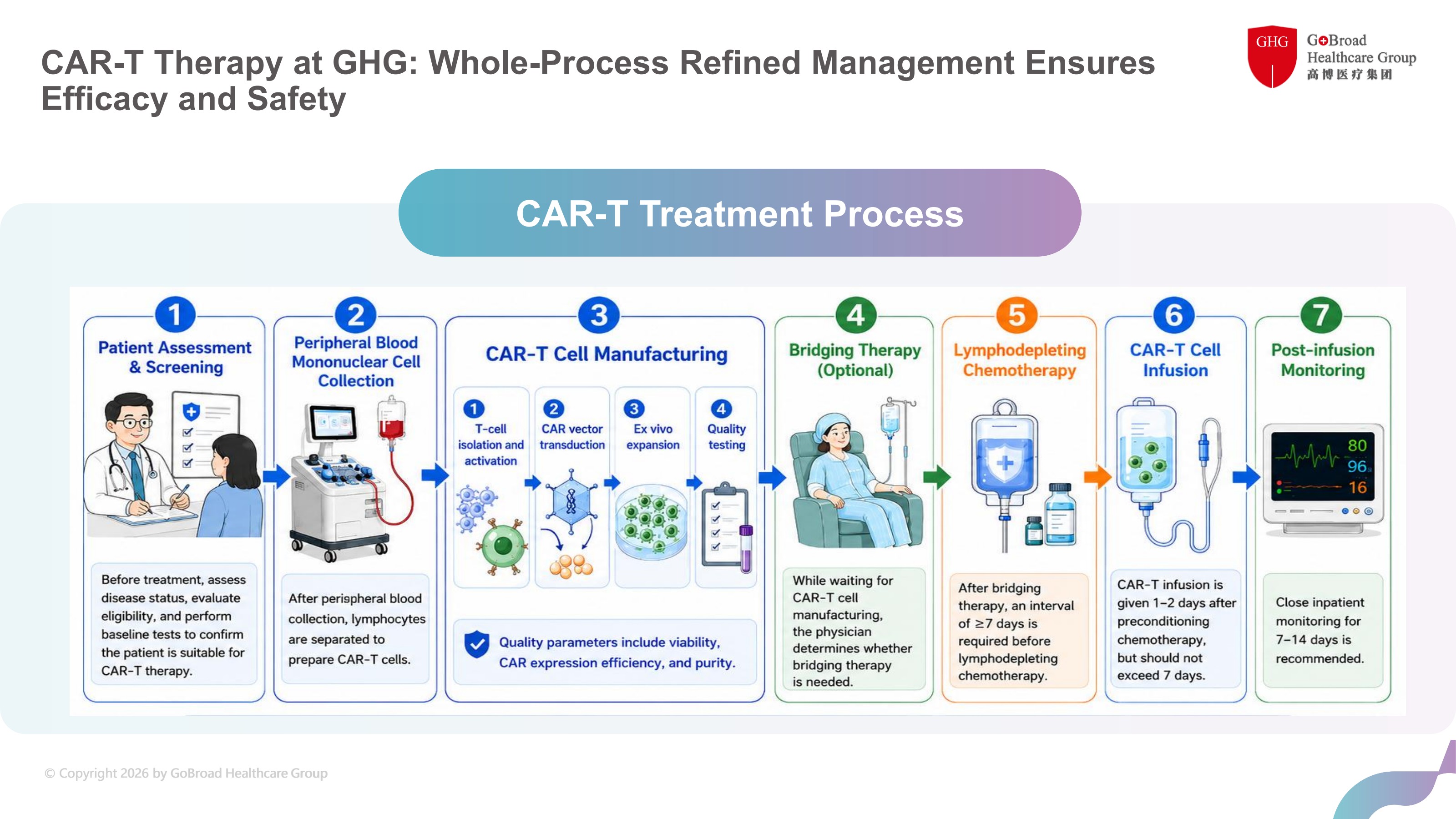
Disease status, eligibility and baseline tests confirm suitability for CAR-T therapy.
Lymphocytes are separated from peripheral blood to prepare CAR-T cells.
T-cell isolation & activation → CAR vector transduction → ex vivo expansion → quality testing (viability, CAR expression, purity).
While CAR-T cells are being manufactured, physicians decide if bridging therapy is needed.
Conditioning chemotherapy prepares the body ≥7 days after any bridging therapy.
One-time infusion 1–2 days after preconditioning (no more than 7 days later).
Close inpatient monitoring for 7–14 days for CRS, ICANS and response.
CAR-T efficacy is not determined by a single infusion — it is the combined strength of product, manufacturing, clinical care and support systems.
The foundation of target recognition and function — CAR structure design, plasmid quality and stability, viral vector process and titer.
The key to manufacturability and activity — quality of patient cells, culture conditions, expansion efficiency and phenotype.
Comprehensive pre-, intra- and post-CAR-T management — bridging plans, infusion, monitoring and combination therapy.
Rapid ICU response and critical care, specialized nursing, MDT collaboration and long-term follow-up.
One of China's leading cellular therapy centres, with multi-indication, multi-target and full-process management capabilities.
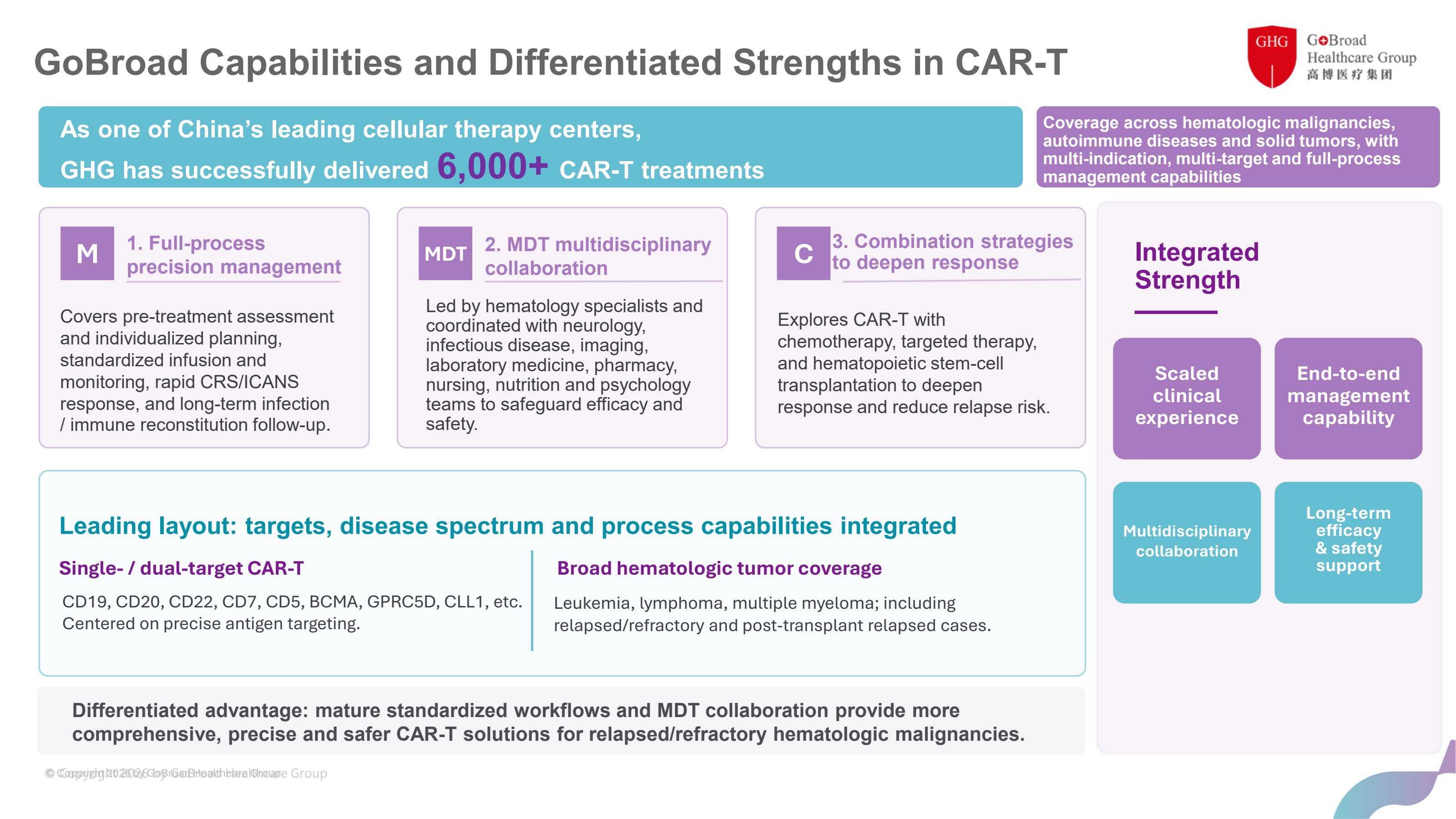
Pre-treatment assessment, individualized planning, standardized infusion and monitoring, rapid CRS/ICANS response, and long-term infection / immune reconstitution follow-up.
Led by hematology specialists in coordination with neurology, infectious disease, imaging, laboratory medicine, pharmacy, nursing, nutrition and psychology teams.
CAR-T with chemotherapy, targeted therapy and hematopoietic stem-cell transplantation to deepen response and reduce relapse risk.
Eligibility is confirmed case-by-case through remote review of pathology, imaging and treatment history.
Selected first-in-world and landmark studies by the GHG team, published in the highest- impact international journals.
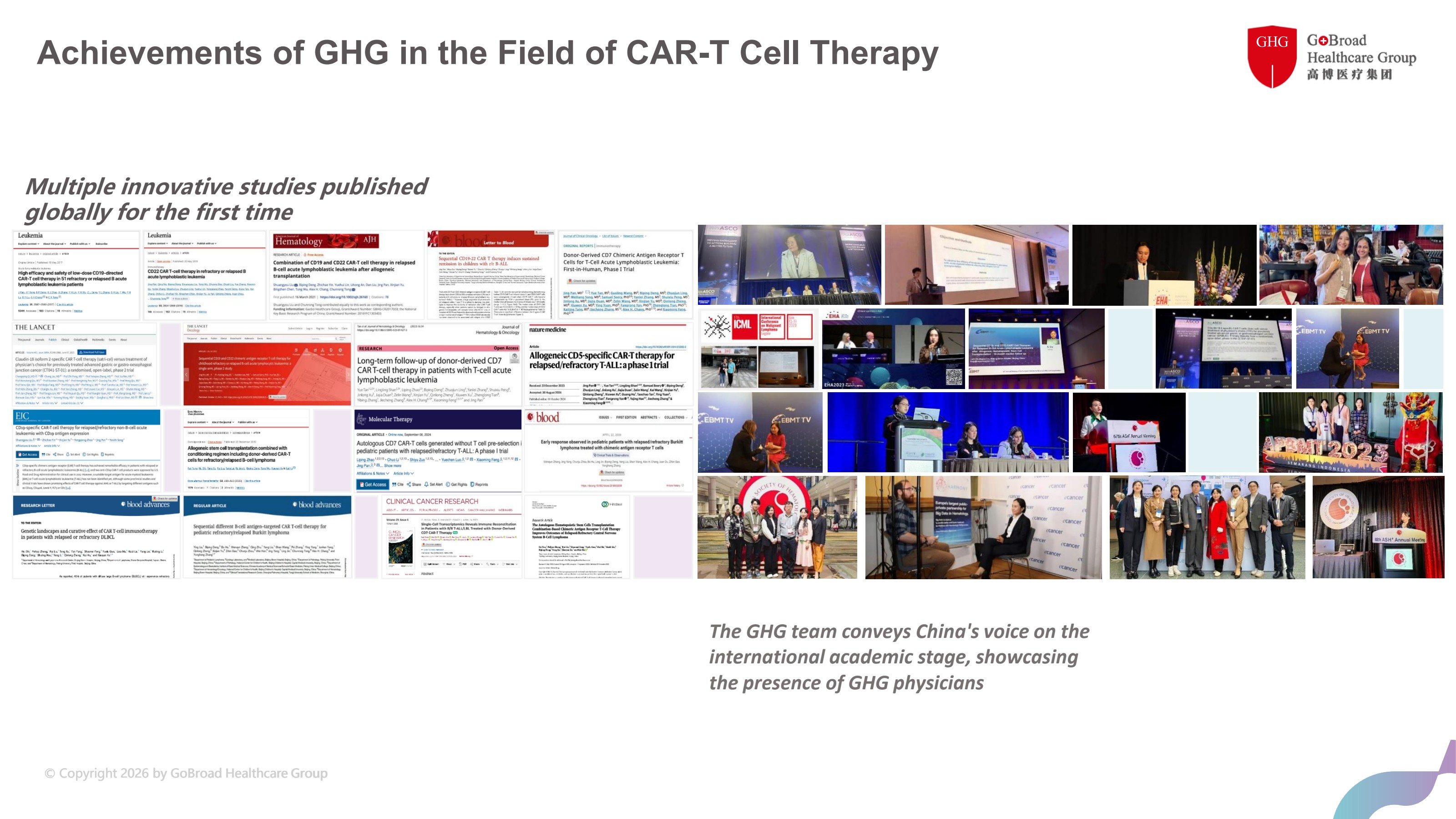
The Lancet
Sequential CD19 and CD22 CAR-T therapy for childhood R/R B-ALL — single-arm phase 2 study
The Lancet Oncology
Claudin-18.2-specific CAR-T (satri-cel) vs. physician's choice in previously treated advanced gastric / GEJ cancer — randomised phase 2 trial
Nature Medicine
Long-term follow-up of donor-derived CD7 CAR-T therapy in T-cell acute lymphoblastic leukemia
Blood
Genetic landscapes and curative effect of CAR-T immunotherapy in R/R DLBCL
Blood
Early response in pediatric R/R Burkitt lymphoma treated with CAR-T cells
AJH
Sequential CD19-22 CAR-T induces sustained remission in children with R/R B-ALL
EBMT
Allogeneic CD5-specific CAR-T therapy for R/R T-ALL — phase 1 trial
Molecular Therapy
Autologous CD7 CAR-T without T-cell pre-selection in pediatric R/R T-ALL — phase 1 trial
Clinical Cancer Research
Single-cell transcriptomics reveals immune reconstitution after donor-derived CD7 CAR-T for R/R T-ALL/LBL
A note on safety. CAR-T can produce cytokine release syndrome (CRS) and ICANS. GHG centres are equipped with dedicated ICU capacity, tocilizumab and steroid protocols, and internationally trained CAR-T management teams — most side effects are manageable and reversible.
Free Case Feasibility Assessment
Based in Hong Kong and serving international patients, Privilege Medical bridges you to leading Class 3A and JCI-accredited hospitals in mainland China. We do not provide medical care directly — we coordinate specialist matching, medical visa support and on-the-ground concierge from your first enquiry to post-treatment follow-up.
Complete the form below. Our coordination team responds within 1–2 business days with a complimentary assessment covering clinical feasibility, specialist matching and an indicative admission timeline.
Privacy Notice
Privilege Medical is a Hong Kong–based medical concierge and does not provide clinical care. Personal data and medical information you submit are collected, held and used strictly for the purposes of case assessment, specialist matching and coordination of medical services in mainland China, in accordance with the Personal Data (Privacy) Ordinance (Cap. 486) of Hong Kong.
Your data may be transferred to our partner hospitals, treating clinicians and authorised service providers (including translators and travel coordinators), some of whom are located outside Hong Kong. We take reasonable steps to keep your information confidential and secure, and we do not sell your data to any third party.
You have the right, under the PDPO, to request access to and correction of the personal data we hold about you, and to withdraw consent at any time by writing to service@privilegemedical.com. Information submitted via this form is not encrypted end-to-end; please avoid including highly sensitive identifiers (e.g. ID numbers) in the free-text fields.